Tuesday, 28 September 2021

Useful web page - A to Z from an MS perspective

Hello all,

The end of the month is fast approaching, which means that its just for me to slide in a short post for my second September post. Those who like to look forward can note that the two October posts should be the write up of the 3rd AGM presentation from the UK support group, and the launch of my 2021 HSP survey. Unfortunately neither of these are quite ready today!

So, here are details of a very useful resource from the Multiple Sclerosis Trust. This is a similar group to the HSP support group, finding information and providing support to people with MS in the UK.

They have prepared an A to Z of things relevant to MS: https://mstrust.org.uk/a-z. The list contains details of treatments, symptoms and common terms. MS is one of the conditions which is often misdiagnosed on peoples journey to HSP, and there is a good overlap in symptoms between HSP and MS.

So, with the caveat that the advice may not be completely relevant, you can look up the more common treatments used for HSP (Baclofen, Botox, Tizanidine, Gabapentin, etc. etc.) and you can find out where the treatment comes from, what it does and doesn't do. Remember the What does XXXX do for MS may not be the same as what it would do for HSP.

There are descriptions of the MS symptoms like Walking Difficulties, Fatigue, Pain, Bladder/Bowel problems (and so on) and you can get an overview of these. As noted, there is a large overlap of symptoms between MS and HSP, but there are also some differences.

Overall, there is a lot to look at. Being a UK organisation the details on benefits and accessing specialist services are from a UK perspective.

Enjoy browsing!


Wednesday, 22 September 2021

Hereditary Spastic Paralympians!

Please excuse the play on words in the title of this post - I suspect it wont translate well into other languages!

Readers may have noticed that the Paralympics followed after the Olympics, and I knew that there were a few people with HSP who were taking part. This post notes who they are and how they did.

Overall Team HSP has 8 athletes from 7 countries, who in total got 2 Gold medals, 2 Silver medals and 3 Bronze medals. I note that I didnt find out about one of these athletes until after the Games had finished.

Congratulations to all!

Evan Austin

Evan Austin (Team USA) won two medals, a Gold in 50m mens S7 butterfly and a Bronze in 400m mens S7 freestyle. Evan also competed in the finals for the SM7 200m individual medley and the Mens 34 point 100m freestyle relay, and also the 34 point 100m medley relay.


You can read Evans details here: https://www.teamusa.org/usparaswimming/athletes/Evan-Austin and https://www.paralympic.org/evan-austin - his Twitter bio reads: "Professional swimmer and speaker. Massive sports fan. My legs aren’t great but I work with what I got. Born with limits, living without them. Let it ride." 

You can follow: https://twitter.com/E_A_swim and https://www.instagram.com/e_a_swim/ 

Roman Polianskyi

Roman Polianskyi (Team Ukraine) won Gold in the PR1 mens single sculls, setting a new Paralympic record along the way.


You can read Romans details here: https://www.paralympic.org/roman-polianskyi and here https://en.wikidat.com/info/roman-polianskyi. Roman switched from para-canoe to para-rowing. 

I've not been able to find Roman on social media.

Toni Ponce

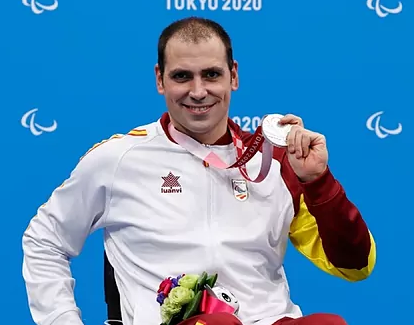
Toni Ponce (Team Spain) won 2 Silver medals in the pool, in the 200m S5 freestyle and the 100m S5 breaststroke. He also competed in the finals for the S5 100m freestyle, S5 50m backstroke and the 20 point 4*50m freestyle relay, and in the S5 50m freestyle.

You can read Toni's details here: https://www.paralympic.org/antoni-ponce-bertran 

You can follow: https://twitter.com/tponce87 and https://www.instagram.com/toni_ponce/

Rebecca Hart

Rebecca Hart (Team USA) won Bronze in the Equestrian Team Test to Music. She also competed in the Grade III individual test.

You can read Rebeccas details here: https://www.teamusa.org/para-equestrian/athletes/rebecca-hart and https://www.usef.org/team-usa/athletes/rebecca_hart. Rebecca has written to the UK Support Group: https://hspgroup.org/wp-content/uploads/2020/05/045-Sept-2018.pdf

You can follow: https://www.facebook.com/RebeccaHart136/ or https://www.youtube.com/results?search_query=rebecca+hart+para+equestrian

Laila Suzigan Abate

Laila (Team Brazil) won Bronze in the 20point 4*50m freestyle relay. She also competed in the S6 400m freestyle final and the S7 100m freestyle and S6 50m freestyle.

You can read Lailas details here: https://www.paralympic.org/laila-suzigan-garcia 

You can follow: https://www.instagram.com/lailasuzigan/ or https://www.facebook.com/lailasuziganoficial

Ian Marsden

Ian (Team GB) competed in the final for the Men's KL1 200m Single Kayak.


You can read Ians details here: https://paralympics.org.uk/athletes/ian-marsden and https://ianmarsden.com/. Ian used to compete in power lifting (holding 3 world records) and switched to para canoe.

You can follow: https://twitter.com/IanMarsdenGB or https://www.instagram.com/ianmarsdengb/

Hallie Smith

Hallie (Team USA) competed in the final for the Women's PR1 Single Sculls.


You can read Hallies details here: https://www.teamusa.org/us-rowing/athletes/Hallie-Smith Her Twitter bio says: "Team USA Paralympian 2020ne. Coach, athlete, and advocate. Hereditary spastic paraplegia, so my legs are for aesthetic purposes only"

You can follow: https://twitter.com/smithonwheels or https://www.instagram.com/smithonwheels/ or https://www.facebook.com/HallieSmithParaRower/

Austin Smeenk

Austin (Team Canada) competed in the finals for the T34 100m and 800m. 


You can read Austins details here: https://paralympic.ca/team-canada/austin-smeenk and https://www.paralympic.org/austin-smeenk

You can follow: https://twitter.com/austin_smeenk or https://www.instagram.com/austinsmeenk/ 


Tuesday, 31 August 2021

2021 AGM - Falling With HSP

The 2021 AGM presentations followed the path established in 2020, with talks scheduled after the AGM on separate days. Our second presentation was Coralie Seary who is a physio from the National Hospital for Neurology and Neurosurgery in London. She talked about falling with HSP. Her work is in the clinic rather than research and she specialises in helping people with walking difficulties, most usually with FES or orthotics.

You can see the video of the presentation here: https://www.youtube.com/watch?v=f68yaDzYtvQ

Most of the information about people who fall is based on the elderly. One in three people who are over 65 have about 1 fall per year, increasing to one in two over 80. Those with neurological problems are twice as likely to fall as those without.

If you have a serious fall it can lead to a serious spiral with people fearing falling, people being less active, leading to decreases in strength or balance, leading to another fall, and so on.

There is a range of falling, with the most extreme being falling to the ground, but there are also near misses where you can prevent yourself from falling, and trips and stumbles. 

Falling is normal! Some falls can be considered acceptable whereas others are not acceptable. Acceptable falls are ones where you dont injure yourself or have a head impact. They might also occur where you are in a challenging balance situation - perhaps uneven/slippery ground or during sport/exercise. Unacceptable falls are where you do have injury/head impact, if it is a normal everyday activity or if you are in a vulnerable population. Coralie noted that having HSP is more likely to put you in a vulnerable population.

Risk Factors for Falling - Intrinsic

There are a number of generic risk factors which increase your risk of falling. If any of these apply then with some management they may reduce your risk of falling.

  • Being older (older than 65)
  • Having a walking impairment
  • Having other chronic conditions (perhaps arthritis)
  • Reduced muscle strength
  • Impaired balance
  • Fear of falling can increase your risk of falling again
  • Dizziness (perhaps from postural hypotension)
  • Inner ear/vestibular problems
  • Vision (make sure your glasses prescription is up to date)
  • Foot problems (painful corns, toenails, appropriate footwear)
  • Poly-pharmacy - taking multiple medications
  • Alcohol
Pairing one or more of these with HSP can increase your risk of falls further. Some of these can be managed to improve risk.

Risk Factors for Falling - Extrinsic

There are a number of other risk factors which increase your risk of falling.

  • Light levels - either very dark or bright glare
  • Obstacles around the house - wires, rugs, piles of books/toys, etc.
  • Surfaces that you walk on - can choose footwear/aids to help in some circumstances
  • Footwear - some types of shoes can help walking. Make sure shoe laces are tied
  • Clothing - long clothing can get in the way of walking
  • Ergonomics - minimise the number of turns you have to do to complete tasks, for example making a cup of tea in the kitchen 
  • Use of inappropriate walking aids - check your aids are still appropriate, and clear out old ones.
Similarly, these can be considered so that you minimise the risk of falling.

Risk Factors for Falling - HSP Specific Factors

There are a number of other HSP specific risk factors which can increase your risk of falling.

  • Gait patterns - inversion of joints, knees
  • Weakness - hip areas, of perhaps its the timing of movement rather than weakness
  • Stiffness - can cause imbalance
  • Alignment of bones - can change centre of balance
  • Sensory changes - e.g. change in information from skin to brain
  • Fatigue - plan your day and energy use according to your expected fatigue levels
  • Bladder problems - urgency can increase risk of falls, including at night.
  • Reduced capacity for dual tasking

Aids to reduce risk of falling

There are aids which you can use to reduce risk of falling (and improve mobility), but it is recognised that often people have difficulties accepting the need for these devices. The best approach is to get used to using aids before having a fall, so some acceptance is needed.

Orthotics are external splits or aids to help pick your feet up and/or stabilise your gait. They can improve stability and/or the swing of the leg. 

Off the shelf orthotics are more flexible and can be a good introduction to using them. Custom made ones are usually more rigid and give you more control of the ankle/foot.

Insoles (or FFO, functional foot orthoses) can help control pronation (where feet roll in) or supination (where the foot rolls outwards).

Choosing your footwear can help a lot. The important factors are the shape of the sole, with a reasonable wedge to raise the heel and a toe spring at the front to help roll forwards on your foot. Some people find high boots are useful, and there are options for adapting existing shoes.

Neoprene or fabric ankle/knee supports/splits can give some support. Some look sporty others attach to your shoes. Carbon AFOs can give you some energy back when walking. The last type is a custom-made plastic AFO which gives the most support. The AFO can help re-align the leg and hip to improve gait. There are advantages and disadvantages to each type depending on what you need to do. There is NOT a one-size fits all approach for these with HSP.

An FES system stimulates the muscles when you move. They do not give you support when you stand still. They can help you walk further. Evidence suggests that using FES can improve peoples confidence walking rather than their walking speed or funciton.

Other aids to minimise risk of falls that you could use are walking poles, mobility scooters, wheelchairs, grab rails, stools (for sitting on), rollators/trolleys, adaptions to bath/shower. You may need different aids in different situations - indoors/outdoors, at home/away, etc. If you have these around your house and do not use them any more they can be an obstacle - get rid of them!

What else can you do?

  • Exercise can help. Tai Chi is beneficial in older people in reducing risk of falling, and the benefit could be extrapolated for use in HSP or other neurological conditions 
  • Strength and balance training is useful.
  • Exercise should be high dose for benefits (least 50 hours over 6 months). Do something you enjoy!
  • Stretches - maintain mobility, especially in calves
  • Look at diet to maintain bone health - take calcium and/or vitamin D if diet is suboptimal or your are not doing weight bearing activities

    How to fall

    Plan how to fall. Consider the risk factors above. If you fall in one place then plan for a softer landing. You should relax and protect your head, and fall on your fleshy bits of your body. Falling on your bottom may be better than falling on your wrists. 

    If you're able to, roll into the fall. You can find out better ways of falling - look up approaches that people with cerebral palsy follow - they can fall often.

    Keep your mobile or an alarm handy so that you can get help, and if you live by yourself you may need a key safe so that people can get in to help you. It may be worth keeping blankets/pillows so that you are unable to get up you can keep yourself warm overnight.

    To get up off the floor you should stay calm and assess the situation. It is worth practicing getting up so you've done it a few times. You can discuss falling and getting up techniques with your physio.


    Friday, 27 August 2021

    Symptoms update - my first fall!

    So, I have been meaning to do a blog post for a few weeks giving a symptoms update. I have noticed some further changes in the last couple of months which would warrant a post, but I managed to go further than that and I fell - so that definitely makes the cut for a blog post.

    Cycling Speed

    I have been noticing over some time that my uphill cycling speed is dropping. I need to get into my lowest gear on relatively shallow hills more so than I have done before. This suggests that the power I'm able to deliver is decreasing. I will have to get out and try and go up something quite steep to see if it is possible! On a couple of my more regular routes there are some roads which people are often running along, and I am getting to the point when people running uphill are overtaking me sometimes!

    Fatigue

    This is one of those "is this HSP or not" things - I've been feeling quite fatigued more often, but I dont know if this is because it is due to increased effort moving coming from my gradually increasing spasticity or if it is because I am trying to fit too many things into my day (or indeed both!). I think that the solution is to do less, but I am far too stubborn to give up on things I have started, which makes doing less a challenge!

    Pilates Update

    Since Covid came into play everyone at my Pilates class now has their own equipment which they bring to class (face-to-face classes re-started earlier in the summer). Before Covid I had frequently borrowed a foam block (some 6-8cm think) which I would often sit on to make it more comfortable and to allow my spine to be more upright. When we moved to on-line classes I didnt have a foam block, but I do have a small step (some 15cm high) which my children used to get up to sink height when they were much smaller. This step helps me get more comfortable and allows my spine to be more upright (and I now take this to classes). I suspect at some point I'll need to increase the height again, perhaps to a small stool.

    Also, at a recent class we used power loop bands, which we wore around our thighs at some points and around our ankles at other points. I found this particularly hard work, and I think that these power bands might be another good way of demonstrating what HSP is like to those who dont have it, especially around the thighs.

    Difficulty Standing

    I have previously mentioned in a symptoms update that I find it difficult to stand up from a full squat. The difficulty is now a bit wider than that, and getting up from the floor in many ways is becoming more tricky. I often find that I need to have something nearby to balance on to make it easier to stand up. When I am sitting down on my haunches I often need to use my arms to help stand up, either by pulling on something higher or pushing down to give me an assist getting up. This is partly to do with balance, and partly because I am worried that my muscles wont have the strength to allow me to stand up unadied.

    I am sometimes also having to position my feet and position when standing up from a chair - particularly if it is a low down chair. Sometimes I will need to use my arms to either assist standing or to give me balance whilst standing. I wonder if it is time to start investigating baclofen....

    Stairs and walking

    I'm noting that I am using the bannisters more when going up and down stairs, and that my speed of ascent/decent is slowing down.

    Now that I'm starting to get out and about with other people with the restrictions of Covid lifting I'm noting that my speed of walking is also slowing down. I dont really have any balance problems or difficulties walking, it is just that it takes a little longer to get places, and if I want to avoid my feet scuffing on the ground I have to concentrate on how I walk, which takes a little bit of attention and time. 

    The Fall

    So, I cant really mention having a fall without giving details. I fell whilst doing one of my stretches (the Adductor strech here: https://hspjourney.blogspot.com/2021/05/stretching-routine-2021.html). The photo there shows me stretching my right leg, but I fell whilst stretching my left leg. I had been noticing a bit of weakness there, and the muscle not feeling like it could hold my weight for some time now, but I have always been able to complete the stretch without falling until now (although it has been close a few times in recent weeks). Relating this to Coralies talk at the AGM I put this in the 'acceptable fall' box as I was doing something intentional!

    In detail - I can get my leg onto the bed with my knee bent no problem, but the difficulty occurs when I straighten the leg, the adductors do not like that stretch, which I take to mean that they are somewhat spastic and not letting me get the full range of movement I want. I stretched the muscle further than it wanted to go, and it went back to where it wanted to be. The consequence of this was that my knee moved forward, my bottom moved backwards, I was not able to move myself to a more stable position quickly enough, and gravity decided that I would come tumbling down onto my bottom. Nothing was hurt or broken aside from my self-esteem!

    The overall conclusion I draw is that my adductors are becoming more spastic, which is limiting the range of movement in my leg. The adductors are also used in pedalling my bike, so it may be that the reduction of uphill bike power as well.

    The change that I have made to my stretches is to raise my leg to a lower height for that stretch so that I can keep my balance much more easily.

    ** Addendum 28th August 2021 - Symptoms Update from August 2020 **

    After posting the text above I was scrolling through my draft posts, and realised there was this draft from August 2020 which I feel I didn't quite finish. So, here it is (with just a quick re-read and minor tweaks in brackets) 

    I was taking a few minutes to track my first six months (of 2020) data in my spreadsheet the other day. There are a couple of things which have happened, and I am not sure that I have blogged about them previously. There are also a couple of other more recent changes, so this is a good opportunity to pop several things down in one place.

    Stretching Routine

    For quite a while I have only been doing one set of stretches per day. I had a look back through my Fit Bit history to work out when this started, and it turns out to be May 2019. Since this time I have dropped the evening stretches and kept up the morning ones. With one set per day I am being more rigorous with making sure that I do them (including the recently added crossed leg stretch), and that each session lasts for longer. 

    Having said that, perception can be a funny thing. I reviewed the last few months worth of exercise logs, and whilst there are several weeks where I log 7 sets of stretches there are also several weeks where I'm down by a set or two. The reality is that I did drop some sets of stretches during corona virus, I didnt feel there was enough time to do everything, and on some days I took the choice to go on an early morning bike ride instead of do my stretches. Having to juggle; my work, being a part-time primary school teacher (during Covid lockdowns), things for the HSP Support Group, having some fun, getting some exercise and looking after my wellbeing all at the same time took a lot out of me and there was a fair bit of "dynamic re-prioritising" over this time! 

    Bladder Medication

    Back in mid 2019 I noted in a symptoms update post that I was trying the first of two approaches for bladder medication - i.e. taking the pill first thing in the morning rather than just before bed. This had been working well, although I was still noting the odd time when I was having some urgency issues. Earlier in 2020 I need to have a phone appointment with my GP to review the medication, and after discussing this we took the second option for a try - i.e. have half-dose pills and taking them twice a day instead of first thing in the morning. I take my two pills one first thing in the morning and the other at bedtime. I realise this isn't equally spaced in the day, but the timing works well. Again, I think this is also working well, and I think that the urgency problems have gotten smaller again.

    Readers that have been reading for some time may remember that I swapped from Detrusitol to Neditol bladder medication in 2016 as there were some issues with getting supplies of Detrusitol at that time. I had left the dose information on my Symptoms Timeline page the same as the box clearly indicates that the dose is equivalent, however when I next update my Symptom Timeline page I will change the dose information to be more explicit about which medication and my dose.

    Muscle Discomfort

    A new symptom for me is that I am starting to find that my lower leg muscles are giving me a bit of discomfort, particularly in the evenings. If I leave my legs in one place then I can feel that there is some tension in the muscles which grows sufficiently so that I have to move my leg. I dont need to move my leg much, perhaps a few degrees change on the knee joint, or crossing my feet, or twisting slightly to one side or the other. I have a telephone appointment with the National in the autumn, and I'll bring this up with them as well and see if this is HSP or something else.

    Walking and Cycling Limit

    I think I'm noticing that my walking and cycling distances are becoming more limited again. For walking I need to find somewhere to sit down after shorter intervals. I know that I have mentioned this before, and it may only be a need to sit down for a couple of minutes, but my perception is that the distance/time between these "need to sit" pauses is becoming shorter.

    On the cycling front, things have changed a little with corona virus, I have been working at home all the time since March (2020), which means that my biking has been entirely for pleasure since that time! At the tail end of last year I had sort of settled on needing to stop every 30km or so for a bit of a rest, and my approach was to try and plan my routes so that there was an enjoyable pub or cafe to stop at! At the start of lockdown pubs and cafes were all shut, so I had to go armed with snacks and stops were all open spaces with benches near my route. I think the conclusion is that the cycling limit is variable - some days I will need to stop and have a rest after 20km, whereas other days I can do a 40km plus route with only the odd brief pause. 

    Saturday, 31 July 2021

    2021 AGM - Spectrum of HSP genes in the UK, building a biobank/registry for future biomarkers and trials

     The 2021 AGM presentations followed the path established in 2020, with talks scheduled after the AGM on separate days. First up was Professor Henry Houlden of the National Hospital for Neurology and Neurosurgery in London. He talked about the spectrum of HSP genes in the UK and about building a biobank or registry for future biomarkers and trials.

    You can watch the presentation here: https://www.youtube.com/watch?v=HtgQO-_vNBQ

    What is HSP?

    Henry began with an overview of HSP. HSP is a genetic condition caused by a mutation in your genes genes. HSP is usually caused by a mutation in a single gene, and this applies to all people with HSP even if your gene has not yet been identified. It is also important to note that if you have HSP it is unlikely to be the cause of all other issues with your health - HSP may be your main diagnosis, but it will not be the cause of all issues. 

    Henry showed a few videos of some of the key features of HSP, starting with a spastic gait and toe-walking. He also showed some tremors, some clonus, and later eye issues and balance issues. With a stiff gait it is often difficult to take a step back to steady ones self, which can lead to balance problems.

    HSP falls into two main types - 'pure' and 'complex'/'complicated'. 'Pure' HSP has three main symptoms - stiffness, balance issues and pain. 'Complex' HSP has these main symptoms and other symptoms as well, which can include memory/thinking issues, seizures, deafness, speech issues or neuropathy.

    HSP onset can be grouped into four categories, those with onset in early childhood, those with onset before age 20, those with onset after age 20, and sporadic/idiopathic HSP. sporadic/idiopathic HSP usually occurs later and often presents a diagnosis challenge.

    A typical person with HSP (and no known family history) would start to develop tripping or scuffing issues in their teens or twenties, with comments sometimes made that they are not so good at sport. Over time they would develop some stiffness and some bladder problems or back problems, and ending up getting a diagnosis in their mid thirties.

    Prevalence and Inheritance 

    At the moment the prevalence of HSP in the UK is unknown. Henry suggested that it may be around 1 in 10,000, but this is his view rather than a number backed up by data. A prevalence of 1 in 10,000 would suggest there are 6 to 7 thousand with HSP in the UK (the population being some 66 million).

    The two main types of inheritance are dominant and recessive inheritance. For types of HSP which inherit dominantly one parent who has HSP has a 50% chance of passing it onto their children. For types of HSP inherit recessively both parents must carry the HSP gene and pass it on to their child for HSP to occur. People with one copy of the gene are unaffected. In the UK dominant types of HSP are more common than recessive types of HSP, but the prevalence of different types of HSP is not known.

    With dominant types Spastin or SPG4 is the most common type. Some 25-45% of people with HSP have the Spastin/SPG4 type of HSP. The next most common dominant types are Atlastin/SPG3A (some 7%) and REEP1/SPG31 (a few percent). Symptoms for SPG3A and SPG31 are similar to those of SPG4.

    With recessive types Paraplegin/SPG7 is the most common type, with Spatacsin/SPG11 and SPG15 next. Up until relatively recently it was understood that SPG11 was more common than SPG7 in the UK, however there are now known to be more cases of SPG7. UK biobank data indicates than some 1-2% of the population carries an SPG7 mutation. SPG11 and SPG15 usually are more severe than SPG7.

    Over time the number of identified HSP genes is increasing, with Henry expecting that a genetic diagnosis will be possible for all people with HSP in the next 10 years or so.

    There are examples of people with dominantly inherited HSP where neither parent has an HSP diagnosis. Historically this has often been due to the affected parent dying an earlier age or because older generations have often avoided getting diagnoses for their health conditions, particularly when then would have had to pay for their appointment.

    In the clinic

    At the neurogenetics clinic around one third of their patients have HSP, and the proportion has been gradually increasing over time.

    The initial step is to get a clinical diagnosis. The person would be examined, their family tree examined, and they would have an MRI or CT scan. The family tree is examined because that can help determine the type of HSP (and the mutation) which affects that family. There would be one gene which affects each family, but the overall number of genes increases which can make it more difficult for doctors and healthcare professionals to keep up to date.

    An MRI or CT scan is taken to check that nothing else is going on and that there are no other risk factors to worry about. This is to avoid the situation where an individual is labelled as a person with HSP and all subsequent symptoms are blamed on their HSP. In practice they are just as likely to acquire other illnesses as the rest of the population. If you have not had an MRI/CT scan then you should ask for one next time you see your neurologist.

    Those who are affected by speech issues or slurring can be at higher risk of chest infections. Some with SPG7 are affected with vision issues, which can affect their driving as they are moving their head more to look in different directions, with consequential neck ache.

    A blood sample is taken for DNA analysis. The DNA is extracted from the blood and is sequenced. The analysis looks for differences between the person and others without HSP of for similarities between the person and family members. Some in the clinic also give a skin fibroblast to aid/promote research.

    They like to see people in the clinic every year or two. They have found that face-to-face appointments have been better than telephone appointments.

    Treatments

    There are no treatments at the moment to reverse HSP, and all treatments are around supporting the person with HSP. Key points are:

    • Physiotherapy - to help with spasticity
    • Baclofen (or Tizanidine or Dantrolene) - to help with spasticity
    • Self-catheterisation or Detrusitol - to help with bladder issues
    • Use of high walking sticks - to help with balance/posture
    • Gait changes can increase wear and tear on hips/knees
    There are limits on the use of Baclofen or its alternatives - some people find that these drugs make them very drowsy.
    Some people prefer the use of high walking sticks to more conventional walking sticks as they can make someone look "less disabled"
    Over time wear and tear on hips/knees may require pain medication and/or joint replacement.

    For complex types of HSP other types of medication can be used, for example those that are prescribed for Parkinson's. Baclofen was originally developed for Multiple Sclerosis. 

    Future Treatments

    There are three main paths for developing future drug treatments:

    • Repurposing drugs for other conditions. This can be quicker, but as the drugs were not made for HSP they may not work as well as they could.
    • Using gene therapy. This approach is being used successfully in Huntingdon's Disease and SMA (Spinal Muscular Atrophy)
    • Undertaking basic research into HSP - but this is slower
    In order for drug companies to work in HSP there would need to be a compelling case. These companies are out to make money, and the compelling case can be made easier.

    HSP Registry

    One way of making it more enticing for companies to work in HSP is to have a registry of people with HSP who are either ready to take part in trials or who have already donated samples which are ready to be used.

    The registry would need to know basic details of the person, including which type of HSP they have. In the UK their data would most likely include their NHS number. The registry would know if there are samples of blood/skin/urine/saliva/spinal fluid available. These samples would ultimately be used as biomarkers to allow the benefits of the candidate drug to be measured.

    A registry would also have the potential to help consultants in their diagnosis of HSP in new patients and help the management of HSP in all patients.

    It would also be possible for the registry to better inform the overall prevalence of HSP and better estimate the prevalence of each of the types of HSP. 


    Thursday, 8 July 2021

    HSP Support Group 2021 AGM

    This weekend was the 2021 AGM for the UK HSP Support Group, which as readers might be aware, I am the chair of.

    The AGM was held by Zoom again, and we had about 40 members watching. Like last year we ran the AGM on one day with the presentations being run on different weekends over the summer.

    Anyone who would like to watch the AGM is welcome to do so, on the groups YouTube channel.

    AGM: https://www.youtube.com/watch?v=JGEET9D45rU

    Channel: https://www.youtube.com/c/UKHSPHereditarySpasticParaplegia

    Highlights for me were hearing our award winners telling us about their awards. It was really good to hear these stories and what people feel about helping the group.

    If there are people reading this who dont know about HSP I took a few minutes right at the the start if the AGM to give a brief overview, so people could click and watch this if they wanted.

    My other main call out is for help for the group - I covered this at the AGM with four main things for this year:

    • New treasurer - our current treasurer is standing down at our next AGM
    • New secretary - our current secretary is standing down at our next AGM
    • New chair of meetings committee - our current chair is standing down
    • More trustees - we could do with some alterative/more diverse views at our meetings
    There is a page with this and other details here: https://hspgroup.org/want-to-be-able-to-help-the-group/ or any interested parties can drop me a line here.

    The dates for our summer presentations are:
    • Henry Houlden – Sat 17th July 15:00
    • The spectrum of HSP genes in the UK and building a bioresource for future trials
    • Coralie Seary – Sat 31st July 14:00
    • Falls prevention and management
    • Ray Owen – Sat 28th August 15:00
    • Mindfulness, acceptance and values
    The most exciting thing, however, was the interest for our newest event - can the group get virtually from Lands End to John O'Groats? The final details for this are just being finalised, it should be really good!


    Sunday, 27 June 2021

    ED&I Hats

    I'm gathering hats these days!

    For a few years now I have been on the committee for the disability staff network at my work. For those of you know me predominantly through my role with the HSP Support Group, those HSP activities are all voluntary, I also have a salaried job which keeps me busy during the day! I work for Atkins (https://www.atkinsglobal.com/homepage) and there is a staff network here for people with disabilities. Atkins has recently become a Disability Confident employer, and we're working on: helping those without disabilities understand more about what it means to have a disability, providing a supportive community which people with or affected by a disability can take part in, and making sure that the companies policies and procedures are appropriate for those with disabilities.

    Actually, there is nice matching between the staff networks and the protected characteristics of the Equalities Act, so what our group does for disability, other groups do for gender, ethnicity, parenthood and so on.

    My latest hat is for the ED&I group which is being set up by the Institute of Acoustics (https://www.ioa.org.uk/). My profession at Atkins is an acoustician, and I am a member of the IOA, which is the professional body for those working in/with acoustics in the UK. The ED&I group at the IOA is aiming to cover all of the different areas where people face inequality or exclusion. Naturally, I bring a disability perspective to this group which complements the perspectives of the others on the group, and between us we start with nearly all of those protected characteristics covered.

    You can see a photo of our initial meeting (held virtually, of course) here:


    I borrowed this pic from this tweet: https://twitter.com/TheANC73/status/1407286245903015947/photo/1. Angela who took the photo is the IOA diversity champion, and was invited to take over the Association of Noise Consultants twitter for international women in engineering day (INWED).

    Those that haven't seen me for a while may note that I am wearing glasses in this picture. These are my latest "getting older" accessory!


    Sunday, 20 June 2021

    Symptoms Update

     Hi,

    Just a brief post today. In the last week or two I had an on-line appointment with a neuro-physio (following from the discussion I had about this with the National last year). We went through the majority of my stretches, and I'm pleased to say that these are all pretty much in line with what I need to do, and I'm maintaining a good range of movement in my joints.

    There are two variations I need to make - for my calf stretches I need to keep my body more upright, and I need to try and introduce more calf stretches during the day. Essentially, when I was doing two sets of stretches a day that was better, but out of them all the calf ones are most relevant. These are most relevant because I default to walking around the house on my toes rather than getting my heels down.

    I was encouraged to keep up with my cycling and other activities so that I maintain my cardiovascular health. We discussed baclofen, and the decision is that I dont need this yet. This decision gets reviewed as I find things becoming more difficult.

    In other symptoms, I feel I'm suffering a bit from fatigue more at the moment. I think this isnt entirely an HSP thing though. On the HSP front I'm needing to go to the toilet more in the night which disrupts my sleep more. On the non-HSP front, amongst other things, I'm busy with the combination of working, being a parent, chairing the HSP support group, trying to keep healthy, and attempting to squeeze some fun activities in as well. Time to relax seems hard to find.

    Update: 22nd June - I also wanted to note that generally speaking my left shoe has been wearing out quicker than my right shoe, which could suggest that my left leg muscles are tighter than my right leg muscles. Whilst the evidence suggests that is true for walking, it is not true in all cases. For example, when I am in the shower, I find it easier to clean the bottom of my left foot than the bottom of my right foot, suggesting the opposite - right leg muscles are tighter than left leg muscles. 

    My conclusion is that the more spastic muscles in my left leg are just different from the more spastic muscles in my right leg. I'll keep an eye out for change over time and spot any other left-right differences - e.g. seeing if it is more easy/difficult getting on/off the other side of my bike, or favouring a certain leg first going up/down stairs.

    I have now also re-started a short set of evening stretches, just a few for 5 mins. Seems that I prefer the routine rather than the ad-hoc when it comes to stretching.

    Monday, 24 May 2021

    Stretching Routine 2021

     Hi,

    I mentioned in a recent post that I had updated my stretching routine recently. The pictures below show all of my current stretches, in the order that I do them:

    Hamstring


    I start with hamstrings - I have always tried to touch my toes as a measure of if the stretch makes any difference. Back in 2018 I noted that some days I can touch my toes and other days I cant. These days it is much more that I cannot touch my toes at all. I do each leg twice, each stretch for about 20-30s.

    Adductor


    As noted in 2018, I focus on keeping each leg as straight as possible, and my body upright. This is a  tricky position to get into this position, and I am often use the wall to help, probably more so than in 2018. I do each leg for 20-30s.

    Calfs

    This is a stretch in 2 parts, in each case trying to keep feet flat on the ground, legs straight and in line with my body. For the second one I each leg, each of the three stretches are 20-30s long.


    Calfs and Adductors 


    These two stretches finish off my calf and adductor stretches, and the second gets me extension in my chest. I hold each for some 20-30s.

    Sitting Cross-legged


    This is a new one. I realised that I had written quite a long time ago that I found sitting cross-legged uncomfortable as a child. I had generally avoided sitting cross-legged since then because of this discomfort. I sit like this for 20-30s, then swap my legs over and repeat the other way round. I concentrate on getting me knees lower. I added this after I added the next one, but do these first!

    Perhaps over time I'll see if I can do this without leaning against something!

    Cobblers Pose


    This is a yoga pose as recommended by the German Geh(n)-mit-HSP study. Again, they show this without leaning against something. I concentrate on getting my knees down, and hold this for some 20-30s. You can see details here: https://www.treathsp.net/klinik/physiotherapie/uebungen

    Hip Flexors


    This stretch is a change from the way I did this in 2018, as I now do this like a forward lunge, but my knee is on the ground. I concentrate on pushing my hips forward to get the stretch, and do each side for some 20-30s.

    Abdominal Stretch

    These two stretches are new, and they were recommended in the German Geh(n)-mit-HSP study. I hold each for about 20-30s.


    I think that I have noticed a difference with these stretches. I have found that my spine is more mobile in some Pilates exercises. Previously when lifting or lowering into/from a bridge position my spine was very blocky, and now I can feel more vertebrae individually. 

    I became aware of these in Jan 2021, so it has taken me some 4 months of doing these to notice the difference in my spines flexibility.

    Plank


    Adding the plank after the ab stretches was a straightforward thing to do, and I hold this for some 20-30s, just to help my core strength.

    Roll-downs


    I finish with three roll-downs from Pilates, just to help with my spine articulation and general flexibility. I concentrate on flexing my ribcage, and as per 2018 my legs stay slightly bent throughout.

    Overall Timing

    So, there are more stretches here than there were in 2018. I still mentally count each stretch rather than use a timer. I do these stretches once a day, usually not long after I get out of bed, which differs from 2018 when I would do one set in the morning and another set in the evening. The total time for all stretches is typically 17 minutes (as measured with FitBit). I can get these all done in a little over 15 minutes if I rush, and some days it will be getting on for 20 minutes by the time I finish. The overall time doing stretches per day is similar to that from 2018. Now that I only do one set per day I am more rigorous about ensuring that I do these, so only a handful of days with no stretches, most often if I am away.

    If you would like to compare these with the same from 2018 - see here: https://hspjourney.blogspot.com/2018/04/stretching-routine.html

    You can also read about the German project here: https://hspjourney.blogspot.com/2021/01/which-physiotherapy-helps-with-hsp.html

    I also wrote recently about why we do stretches here: https://hspjourney.blogspot.com/2020/05/why-do-stretches.html


    Saturday, 15 May 2021

    Mental health awareness week

    Hello, this post is a little later than I would have liked as mental health awareness week is coming to an end, but it has taken me a few days to reflect on what I wanted to post about.

    To me, if you have a rare disease (like HSP) or a disability there seems to be quite a burden with potential to affect mental health. This post simply seeks to note down those areas.

    Uncertainty

    Simply, when you have a condition there are many more variables which can affect your future in ways that you cannot evaluate. Your future is less certain, and that uncertainty can be a burden, more so if you are the type of person who likes to plan their future in great detail.

    Understanding

    The burden of a condition or a disability is greater if you don't know about it. Understanding can be improved if you know:

    * The name of your condition/disability and you have a firm diagnosis

    * What symptoms might occur (and how they might affect you)

    * What cures or treatments are available (noting, no cure for HSP at moment)

    This area can be even more frustrating if the healthcare professionals you are seeking this information from do not understand what you have, or what you are seeking the answers for.

    It is important to remember that you may be seeking answers that do not yet exist, and in that case the healthcare professional should be honest with you and say that there is no answer. They may be able to give you their opinion, or an approximate answer, or between you work out where to go looking to reduce this uncertainty. 

    Support

    The old saying 'a problem shared is a problem halved 'is true! Having a disability or condition can be a very lonely isolating experience, especially if you feel like you are the only person in the world going through your situation.

    Being able to talk with someone you can trust can make a massive difference to your wellbeing.  If you are able to find a community of people who have the same or similar conditions can help you feel that you are not so unique, and you will know that there other people who are going through the same things that you are.

    This kind of environment can also help on the understanding front, as within these communities there are people who are happy to share how they have overcome their own barriers, and their top tips for getting through life. You are often able to draw parallels between your situation and theirs and seek a path which you can either choose to follow or choose not to follow. These types of discussion can help reduce your uncertainty.

    The communities can also be a place to share your frustrations and simply voicing these can help. Equally you may find benefit from listening to others share their frustrations. 

    If you don't like the idea of finding a community of people with the same/similar conditions, and there is no-one in your close circle of friends or family that you feel you can talk with, then you could always reach out to more general mental health charities or groups. 

    Change

    We are all getting older, one day at a time, with our lives slowly changing as a result. If you have a progressive condition like HSP then your life may be changing at a different rate or in a different direction to the general path of change with age.

    Having some awareness of potential changes can work either way. Those that like to plan well in advance may benefit from an understanding of how their future may be different from their present. Others may not like to consider how different their future may be. If you have HSP I think it is worth considering potential changes in the following areas:

    * Mobility - your mobility is likely to change, and you may need to think about the use of mobility aids.

    * Other symptoms - pain, fatigue and bladder problems (among others) can mean further changes on top of mobility changes - not everyone is affected by these (or other) symptoms.

    * Travel - changes in your mobility may affect how you can travel, and if you enjoy travelling you may wish to think about how you may travel in the future

    * Employment, hobbies and activities - any of those factors have potential to affect how you can do those things that are important to you. You may wish to think about how you can do things in a different way or from a different perspective to keep doing these important things.

    * Your home - if your mobility changes a lot, you may need to think about changes to your home, to help you be able to move about your home and keep on with those day-to-day life essentials as independently as you can.

    Grief

    If you feel that you are missing out on futures which now seem to be difficult or impossible, then you may be grieving the loss of your future self. Grief is a natural process, but the process of grieving can be painful and take time. You may have to visit this process a number of times as your life changes.

    Acceptance

    If you do not feel that you have the condition that you have been diagnosed with, then you may not be accepting of your current situation. Accepting who you are and what you have can be a difficult process, but once you have accepted this you may be in a better position to consider what your future self may have to deal with. You may have to visit this process a number of times as your life changes.

    Once you accept your own situation you can subsequently start to deal with accepting that others may see you as 'different'. If you have a condition like HSP and your mobility is greatly affected then people will always see your mobility aids because they are different from 'normal'. 

    The acceptance part of using or changing mobility aids is twofold, firstly accepting that you are comfortable using a mobility aid (or a different mobility aid), and secondly accepting that other people will have an opinion about you, your condition and your new/different mobility aids. You cannot control what others think about you, their opinion is more about their upbringing than your situation. You are likely to be balancing the benefits of using the mobility aid against the mental 'cost' of being seen to be different.

    Disclosure

    Following from the process of accepting your own situation comes the next part of the journey, being able to share your story with other people.  

    Some of the time it may not be important to disclose to other people that you have your condition, but in other cases it can be. The benefits of disclosure can be greater when you find day-to-day tasks more difficult, and in these situations disclosing your situation can help improve other peoples understanding of your situation. On the opposing side, once you have disclosed your situation it becomes more easy for you to be put in a different box than you were before, and that (or the potential of that) can be a hard thing to accept. In theory disclosure should open up avenues to support rather than block off progress to your future self, but I accept that it is not always as clear cut as this!

    Depending on your situation you may feel the need to disclose your situation to your family or friends, to your doctor or other healthcare professionals, to your employer(s), to any insurance companies, to your driving licence authority, to your bank or mortgage provider (and so on).  

    Summary

    My journey in this area spends most of the time moving between the Understanding, Support and Change areas with the objective of reducing my own Uncertainty about the future. I don't often need to visit the Grief area, but I do spend some time in the Acceptance area. As my mobility is not affected significantly I have not had to deal much with the Disclosure area in official channels, but I feel that I will need to spend more time considering acceptance before I officially disclose more. 

    In terms of this blog I will carry on sharing my story, in all its forms of disclosure! I will also carry on my annual surveys to share the wider picture of life with HSP, to help people with HSP form their own views about how their paths are different from/similar to others. It all helps me, and from some of the comments I receive I know it helps others too.