Thursday, 19 November 2020

Rare Showcase 2020 Lightning Talk

Today I took part in a lightning talk at the Findacure virtual Rare Disease Showcase.

Findacure have been hosting rare disease events for a number of years, and regular readers may remember that I went to their drug repurposing conference in 2016 (yes, there are posts here about that). One of the support group trustees suggested that I talked about the needs identification which I'm covering in this years survey, and that idea was liked by Findacure, so I was up.

Regular readers will note that I usually write up various points and observations from these meetings, however project commitments at work meant I was only able to attend today. I was working on a range of other support group activities this morning, so I was listening to a few of the other talks in the background.

My key takeaway from those talks were the discussions around how social media can be both a blessing and a curse. A study was being talked about where the participants were sharing their experiences during the trial on social media. The result of all the attention was that even those in the placebo arm of the trial showed changes, and hence the study couldn't demonstrate what it wanted to.

For the lightning talks round I was one of five presenters, and I volunteered to go first. There were a few teething issues with my technology which meant that I went a little faster than I wanted to and finished in 4 mins 26 seconds. It was really good fun to take part in!

I had taken the approach of going for five minutes, five things to say:

  • What is HSP
  • How does HSP affect people
  • Available support networks
  • The approach to needs identification
  • Some early results
You are welcome to look at my slides here: https://drive.google.com/file/d/19kLBCvra33y0Vut5jH9WFxouywd8Kz8C 

The other four presenters were telling the stories of their rare disease experiences, and it was insightful to hear that actually those with rare diseases are often in the same boat - trouble with diagnosis, trouble finding information, trouble finding treatments. Everyone was really friendly, and there were some interesting questions at the end. In summary, great fun!

I'm hoping to get the recording of my five minutes for youtube!

I am quite pleased with my support group network map:


Saturday, 14 November 2020

A week of publicity!

So, this last week or so has seen me being involved in a couple of publicity activities.

One of the other trustees at the support group had recently suggested that we put ourselves forward for a couple of things, and these have been developing nicely recently.

We said that I would be prepared to do a five minute talk in one of the lightning talk rounds at this years rare disease showcase, and out of many, I was selected to do this. In the last week or so I have been working out what to say and what to show. My topic (as suggested by our trustee) was around using technology to identify the needs of those with HSP, so a perfect excuse to draw together lots of HSP strings together, including some of the early results from my survey.

If you wish to watch, you can still sign up for the virtual conference: https://www.findacure.org.uk/rare-disease-showcase/, and my session is on Thursday afternoon. Having had a look at the agenda, there are a load of other excellent sounding talks, a few of which I should be able to attend whilst I am there.


Also, we said that we were happy to take part in the Student Voice competition, and I was paired up with a student to talk about my experiences with HSP. The competition is here: https://www.findacure.org.uk/student-voice-prize/. We had a good chat and I was able to share many aspects (including some other early survey results!), and we should find out soon the result of that competition soon. If that essay is the winner, then HSP will get a mention in https://ojrd.biomedcentral.com/


Tuesday, 3 November 2020

HSP on YouTube

 Since my latest venture becoming a YouTuber, I have been meaning to find time to watch various other relevant HSP things in order to report them here.

Finding that time seems to be somewhat challenging at the moment, so I am putting the various YouTube links here, and I'll come back another time to report them. There are two different channels which I mean to look at first:

ERN RND

The European Reference Network on Rare Neurological Diseases (ERN RND) have run a series of webinars over the summer, several of which are relevant to HSP. Each webinar was broadcast on a separate day.

There are five that caught my attention, which I have put the titles and links to in this table below.

Title

Link

Environmental modifiers in Hereditary Spastic Paraplegia

https://www.youtube.com/watch?v=GlmsbKSLTOA

Gait rehabilitation in people with HSP

https://www.youtube.com/watch?v=xR_7A-JVB-E

How to assess and manage spastic gait in rare diseases?

https://www.youtube.com/watch?v=sqznUcJXGsI

Hereditary Spastic Paraplegia (HSP) clinical disease course

https://www.youtube.com/watch?v=vEh4JXi3f9E

Treatment of spasticity in HSP

https://www.youtube.com/watch?v=NzceL8JDwes


There's about 5 hours of watching here. They also have videos on other conditions than HSP, and you can see the full details on their channel: https://www.youtube.com/channel/UCLpEdEyhGnQpdmLLzqNXkTg/videos 

SP Foundation

The Spastic Paraplegia Foundation ran their annual conference on-line, and have uploaded videos of this onto their channel. Their conference ran over three days, and I have included the relevant links into the table below:

Title

Link

SP Foundation: Virtual Conference Day One June 26, 2020

https://www.youtube.com/watch?v=kNxbhCuAOj0

SP Foundation: Virtual Conference Day Two June 27, 2020

https://www.youtube.com/watch?v=IFUBvOZIpbA

Path to Improve Upper Motor Neuron Health

https://www.youtube.com/watch?v=MC6NORfD9uk

Genetic Topics in HSP & Related Diseases

https://www.youtube.com/watch?v=_Zd3Kp5n7eI

HSP: Understanding What's Wrong So That We Can Fix It

https://www.youtube.com/watch?v=C3EmaLMSGTY

Research Advances in the HSPs

https://www.youtube.com/watch?v=61U-Xm42N6o

A Multimodal Strategy to Finding a Cure for an Ultra-rare Disease

https://www.youtube.com/watch?v=nDOyw7qX_uw

There is a video each for days one and two of the conference, and (as far as I can tell) the third day has been split into separate presentations. Overall there is about 9 hours watching here as well. They also have other videos on their channel: https://www.youtube.com/c/SpasticParaplegiaFoundation/videos 

This includes videos from the past three years, and it is worth watching the Q&A with Dr Fink, as these give some great pieces of information.

(p.s. I dont know what happened to October, all of a sudden we have arrived in November! I was planning to put this post up in late October, so that my survey launch post got a long time as most recent post! It makes Oct 2020 only the second month when I have posted just the once - April 2011 being the other one) 


Sunday, 11 October 2020

2020 Survey Open

Hello - it is that time of year again!

I am pleased to announce that my 2020 survey is now open. This year questions are available in English, Italian, Dutch, French, Spanish and Portuguese. Click on the relevant link in the table to below to access the questions in that language.

The focus for this years survey is: 
  • Participation and Activities
  • Needs for those with HSP
  • Access to healthcare
Similar to recent years the analysis of answers will take into account both mobility and wellbeing. I will collect answers until approximately the end of 2020, with results published on Rare Disease Day 2021 - Sunday 28th February.

As with previous surveys only "name" and "country" are required questions. Answer all others that you want. The survey is a similar length to those in previous years, so hopefully would take a similar time.

For the "needs for those with HSP" questions, I am seeking your opinions on what types of information are most important, which makes a change from the usual factual style of questions. I hope that these questions work well!


3rd January

Just starting to look at analysis now. Compared with last year I have:
More responses from: Netherlands
Similar number of responses from: Belgium/Italy/France/Canada
Fewer responses from: UK/USA/Australia/Spain/Brasil

I am happy to have more results in the next few days - especially from those areas with fewer responses!

23rd December - Brief Analysis of ~200 answers.

Here are some results from ~200 answers in English and Portuguese. I would love more answers, a few more will take me over 300 in total. People in UK, USA and Brasil form the bulk of people in this analysis.

About 80% of people consider themselves to be disabled, with similar proportions in all areas of the world.

Some 15-20% of people consider they know HSP very well, with another 40% knowing it well. Most of the remaining 40-45% know HSP somewhat rather than not at all. People feel that healthcare professionals do not understand what it is to live with HSP very well, with 10-15% understanding very well, 15% understanding well, and almost 75% somewhat (<50%) or not at all (~25%). Understanding of HSP seems lower in Brasil than in UK/USA. Nearly 40% were not given a description of HSP when diagnosed, with fewer in UK getting description than in USA/Brasil.

Some 15% of people have had surgery for their HSP, with the two most common types being tendon release surgery and placement of a baclofen pump. Surgery seems most prevalent in USA and Australia.

Some 60% of people have had fewer appointment as a result of Covid-19, and only 5% having more appointments. The availability of digital appointments has increased as a result of Covid-19. Almost two thirds say they were not available before, reducing to around one third after. Before Covid-19 only 15% were accessing digital appointments, increasing to about 55% after. The availability and take-up of digital appointments has been greatest in USA and smallest in Brasil. The key advantage of digital appointments is reduced effort travelling, and the key disadvantage is having less chance to show symptoms.

25th November - Well over 250 now!

8th November - Just hit 200 results. Here are a few early results:
  • Over 50% feel the extent or severity of their symptoms was not believed by medical professionals
  • Over 50% feel they did not get adequate support because they have not been taken seriously
  • Over 50% did not receive a description of HSP when diagnosed with it.
Nearly 2/3 of people have had fewer healthcare appointments due to Covid-19, but there has been a big uptake in digital appointments. Over 50% feel face-to-face appointments are better than digital. The key benefit of digital appointments is reduced effort travelling. The key disadvantage is less chance to show symptoms.

Living with HSP is the most important category of needs, and the most important need is:
  • Stretches and exercises that help. 
Other key needs are: 
  • treatment options for spasticity,  
  • information on improving mental health/wellbeing, 
  • information on accessing relevant healthcare professionals 
  • an explanation of HSP on diagnosis
  • predicting how HSP will progress in individuals 

22nd October - Well on my way to the first 100 results. Thanks!

Friday, 25 September 2020

Clinic Visit, Baclofen and Symptoms Update

 Hello,

I realise that there have been quite a few Symptoms Update posts from me of recent, and I wonder if that in itself is an indicator of a change in my rate of progression, a change in my perception of my progression, or if there is some other factor. I dont suppose I'll know!

Anyway - earlier I had my bi-annual appointment with the HSP clinic at the National Hospital for Neurology and Neurosurgery in London. Travel for this appointment was much easier and much less interesting this time, because it was a telephone appointment!

We generally talked around my symptom changes (more on that below) and about what would be the right change to spot that would warrant me starting to take Baclofen. It appears that this is a bit of a balancing act. It was suggested to me that Baclofen can be used to make me feel more comfortable, indicating that I shouldn't start taking it until I begin to feel some level of discomfort. Looking at various websites Baclofen works by reducing the transmission of nerve signals, thereby reducing any underlying instructions to tense. It appears that many people are affected by side effects from Baclofen, and it seems there is a three-way balancing act:

  • Taking enough to cause the muscles to allow themselves to relax
  • Not taking so much that the relaxation is more than is wanted
  • Balancing these two against negative side effects.
It would seem that if you take Baclofen an hour or so before doing stretches then these stretches would be more beneficial as the Baclofen gives the muscles a chance to stretch longer/deeper.

An initial dose might be 5mg (half a tablet) once a day, so that the body can get used to this new drug, and then increasing the dose up to perhaps 10mg three times a day. The maximum is 100mg over a day, so there is plenty of variation possible in working out the best approach, and when to take those doses in order to get the most out of it.

We talked in general terms about my stretches, and I described that I have been modifying my stretches depending on which muscles feel stiffest. It is probably a good idea to have a review with the physiotherapist, just to make sure that I'm still doing the right sort of thing.

On the stretches front, I said that when I went camping over the summer I didnt do my stretches, and that by the end of that holiday I was starting to feel some discomfort in my legs, particularly my calf muscles. They were feeling tight and uncomfortable. Once I finished camping I re-started my stretches and the discomfort has gone away. It is my view that my stretches are really important to keep my mobility going as long as possible. 

I also explained about the level of activity which I do, and how I do need to stop for a rest every now and again, and I feel I may be on the verge of needing one walking stick. Essentially HSP isn't stopping me do anything I want, sometimes it takes me a little longer to do it. (I noted that I cannot really run, but equally I don't really want to run either). I also think that keeping active and moving about is important in keeping my mobility going as long as possible.

The general conclusion from this chat was that I seem to be doing the right things. Lower back pain was mentioned, which is something which many suffer from. The suggestion was that the lower back pain may come from your body having to use different muscles to walk as mobility decreases and legs become stiffer, so that is another thing for me to look out for. I was advised to keep an eye out on my posture whilst sitting. This is something I'm doing anyway because my job involves using a computer all day, and working at home during coronavirus, has meant that I've reconfigured my desk to be better, and I've bought a better chair to use. Sitting posture has also been mentioned to me before, back at previous consultations, and we pick up on that in Pilates as well.

Summary: Still not ready for Baclofen, Review stretches with Physio, Keep active, Keep stretching, Posture!


Tuesday, 15 September 2020

2020 AGM - Rehabilitation and Physical Activity in HSP - Dr Gita Ramdharry

For the 2020 AGM the technical presentations were held digitally via the Zoom platform, and each one was held on a different day. This blog post covers the third, Rehabilitation and Physical Activity in HSP, presented by Dr Gita Ramdharry from the Queens Square Centre for Neuromuscular Diseases in London.

Physiotherapy 

Gita began by outlining some of the aims of physiotherapy for HSP. A key part of this is understanding walking patterns, and how HSP varies peoples walking pattern. They monitor gait by looking at the amount of movement in muscles and joints, and compare those with HSP against those without. There are two types of muscle stiffness - active stiffness, where there is spasticity and spasms in the muscle, which is caused by issues in the nerve pathway - and passive stiffness, where the muscle tissues become stiff or stuck-down, with stiffer muscles becoming shorter. 

They found, as an example, that during walking the knee does not bend as much for those with HSP. One of the factors leading to this was passive stiffness in the calf muscles. Passive stiffness can be relieved by stretches and splinting, whereas medication (e.g. Baclofen) can relieve active stiffness. Another factor affecting the knee movement was weakness of the calf muscle - if you dont get as much of a push up from the calf muscle, the knee doesnt bend as much. Weakness was also found in other muscles as well. Strengthening exercises can be used to regain some strength in muscles, for example using a resistance band (Gita mentioned Theraband: https://www.theraband.com/), weights, other exercises or functional electrical stimulation (FES). Physiotherapy for those with HSP is a combination of managing stiffness with either stretches or medication (depending on the type) and undertaking exercises to keep muscles strong.

Fitness and Activity   

Next Gita talked about general fitness and activity, and aerobic exercise, noting that physical inactivity is responsible for 1 in 6 deaths in the UK (https://www.gov.uk/government/publications/physical-activity-applying-all-our-health/physical-activity-applying-all-our-health). Gita also found a study into Charcot Marie Tooth (CMT - a related condition to HSP) showing that there is a relationship between peoples body mass index (BMI) and the amount of time they do nothing (i.e. are sedentary) irrespective of if they had CMT or not. She has found that there hasn't been much research done into the benefits of aerobic exercise in those with HSP.  She reported a study undertaken in Norway (https://ojrd.biomedcentral.com/articles/10.1186/s13023-016-0469-0) which showed that people with HSP spent more of their day sitting than those without HSP, and the next element is to look at the impact of this inactivity.

A recent study looked at the impact of impact of inactivity on symptoms of those with HSP from Covid-19 lockdowns in the Nederlands (https://www.ncbi.nlm.nih.gov/pmc/articles/PMC7339095/). The study showed that where people carried on with physical activity as before lockdown there wasnt much change in their symptoms. However, people who said that they were less active during lockdown reported worse symptoms. This provides a backdrop to discussions around why people need to keep themselves active.

Physical Activities in Rare Conditions Collaboration

The next part of Gitas talk covered the Physical Activities in Rare Conditions Collaboration (PARCC) project. Gita began by defining that physical activity is an all-encompassing term for any physical activity which you might do - sports, household activities, gardening, general movement (etc.) whereas exercise is a sub-set of this, which is planned and structured with an aim to improve as aspect of health.  

The PARCC programme began by identifying what was important from those with HSP and other related conditions - Ataxia, Muscular Dystrophy, PSP, Huntingtons, MSA and Motor Neuron Disease. There were a lot common issues between these conditions, both in symptoms and in accessing facilities and difficulties in finding information. The first step was to identify barriers to undertaking physical activity. Common themes were around how healthcare and community facilities are organised, communication with healthcare/fitness professionals, carers and others. There was also common themes for individuals around motivation, worries and knowing what they should be doing.

A scoping review of published works showed no papers around exercise in HSP. So, there is a need to assess this. It was found that from a patient perspective the important aspects to measure for a physical activity scheme are physical wellbeing, psychological wellbeing, and being able to participate in activities. The next stage is to then develop the on-line tool for the project, which will have a range of tools, materials and stories. The project will also offer some one-to-one coaching in how to choose what to do to help with making lifestyle changes to become more active. A grant application has been made for this project, and if the grant is made then work will start!     

You can watch the whole presentation on YouTube: https://www.youtube.com/watch?v=VVEi0VZdtS0&t 


Q&A

There were a few interesting things in the Q&A.

In a discussion around muscles, Gita explained that muscles work most effectively in certain range of the joint movement, and that you are more likely to notice stiffness at the extreme ends of the joint movement.

A question was asked about Revitive power plates. Gita explained that these work in a similar way to functional electrical stimulation, and that needs an intact nerve to work well, so can work well for those with pure HSP or where their nerve degradation is only in the spine, but are less likely to work well when you have nerve damage in/near the muscles.

A few questions were asked about PARC, and Gita explained that should the grant be successful the initial work would cover the four conditions: HSP, Ataxia, Muscular Dystrophy and Inherited Neuropathies. It was also asked how PARC would be certain to get a representative spread of the HSP population. This is partly to do with the numbers of participants, but Gita also emphasised that the program will give every person their own intervention, agreed in discussion with the skilled therapists, so all plans may look different to each other.

It was asked if there might be anything useful for HSP patients in the Bridges Self Management site mentioned (https://www.bridgesselfmanagement.org.uk/) - There might be - go and look!!


Tuesday, 25 August 2020

2020 AGM - Insights from a large regional HSP cohort - Dr Channa Hewamadduma

For the 2020 AGM the technical presentations were held digitally via the Zoom platform, and each one was held on a different day. This blog post covers the second, Insights from a large regional HSP cohort, presented by Dr Channa Hewamadduma from Royal Hallamshire Hospital in Sheffield.

HSP

Channa began with a brief introduction to HSP, acknowledging that it is very variable between patients. He described that the SPG genes are numbered in the order of their discovery, and it took a long time to identify the gene for SPG3 and as a consequence this is called At-Last-In or Atlastin!

The spasticity in HSP is due to the degeneration of the motor axons in the spinal cord. He described that, as a parallel, if the diameter of the motor axon were the diameter of a football, then the length of the axon would be 7 football stadia!

Understanding the potential effects of HSP on an individual requires knowing about which type of HSP the person has. In a cohort of HSP patients some will have a family history, but many will not, they are the first person to be affected. The Sheffield cohort has 420 patients, with a clinical dataset for 371 and a gene identified in 211. Of those with a gene identified about 60% are Spast/SPG4 and around a quarter are Paraplegin/SPG7. SPG7 was thought to be rare, but may not be. SPG7 has a later onset. Cerebral palsy has been a common misdiagnosis for younger HSP patients.

Inheritance and Optic Atrophy 

More than 40% of patients have bladder involvement and around 40% have pain or spasms. More than half of people with complex HSP have optic atrophy. With optic atrophy problems are spotted when the vision is challenged.

SPG7 is one of the genes which shows the spectra of the different overlaps with other conditions and effects. 10% of those in the Sheffield ataxia clinic have SPG7. SPG7 was discovered in 1998. Sheffield has 55 SPG7 patients, and there is a spread between those with HSP, those with ataxia and those with both. The mean age of onset is 42 years.

Further detail was given on optic atrophy. If people are less able to move their eyes they may have been told they have had a stroke rather than have HSP. Optic atrophy in HSP may mean that people are not able to move their eyes equally in every direction. They are hoping to be able to use this as a biomarker for HSP. 

An analysis of published data shows that the age of onset of HSP varies with where the mutation occurs within the gene. If the patient has inherited the same mutation from both parents then their onset may be later than if the patient has inherited different mutations from each parent. If the mutation is sufficient to prevent the protein from working (loss of funciton), the patient would have greater spasticity.

The Sheffield Clinic 

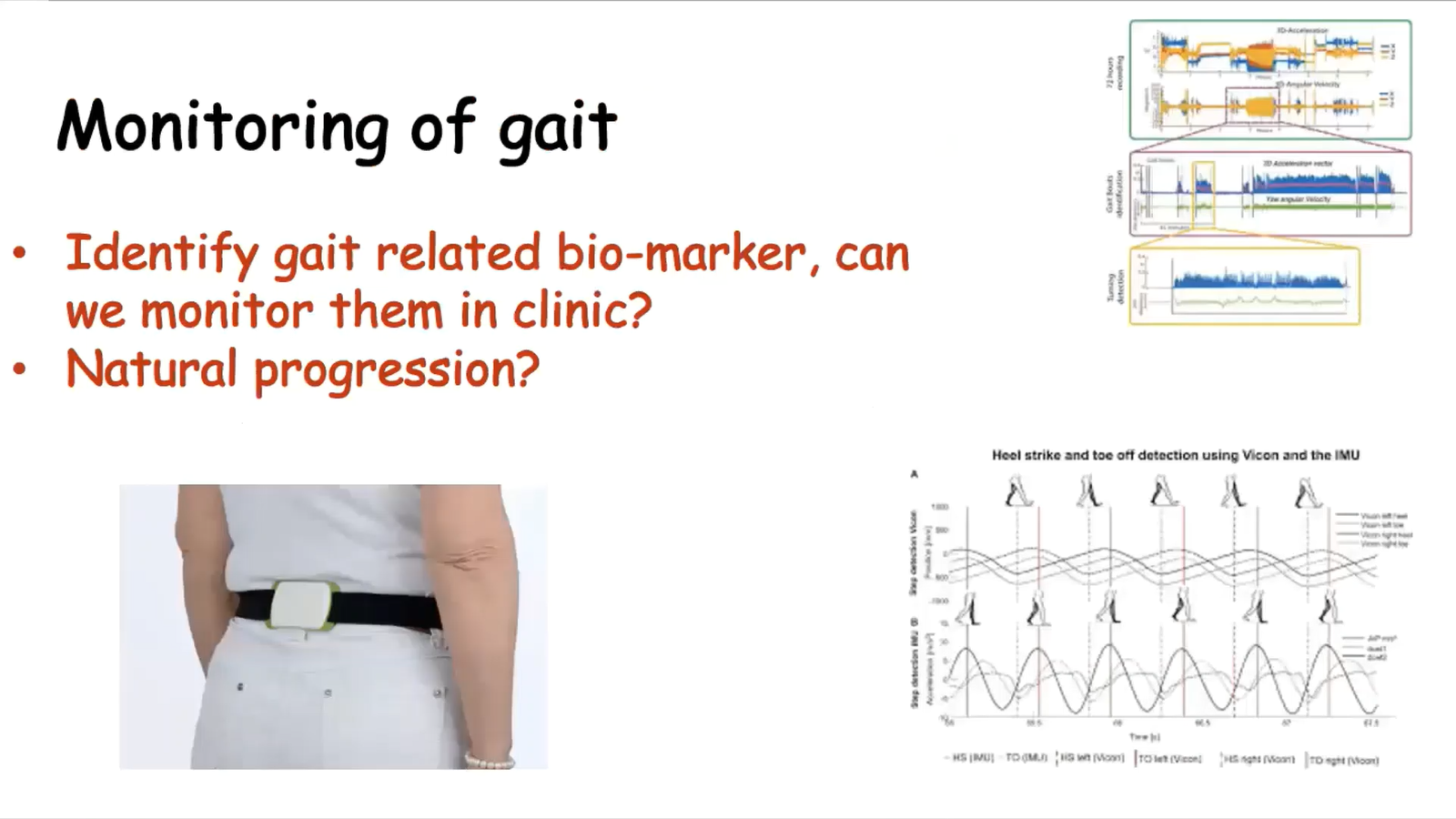
Channa described the in-clinic process for patients, getting an assessment of spasticity, coordination, visual, mood, gait and more. They have a range of interventions available. They are planning to identify the potential for a gait biomarker, to look at the natural progression of HSP and look at the differences between types of HSP.

They have been experimenting with a single sensor gait monitoring, worn on the lower back, which can be used to see how the gait has been affected. Some data was presented looking at a 10m walk test, where a person stands, walks 10m, turns, returns and then sits. Those with SPG4 tend to have more problems standing up, whereas those with SPG7 have more problems sitting down. The gait analysis can also spot effects in mildly affected, which gives them a "trial ready" group of patients.

Future Plans

They are hoping to be able to analyse differences in neuro-imaging to help predict how HSP could progress in an individual.

They are also working on a drug screening programme, looking at the effects of different drugs on cells, from SPG7 , using drugs identified through re-purposing programmes. A high content imaging screen is used to differentiate between cells and controls.

You can watch the whole presentation on YouTube: https://www.youtube.com/watch?v=s3qZqLnNpBY 


Q&A

In the Q&A there were a few interesting points. 

There is no difference between the terms paraplegia and paraperisis.

There are differences in the mutations in specific types of HSP around the world.

Some people get benefits from co-enzyme Q10, some from CBD oils and some from gluten free diets. A study is planned around the gluten free diet.

For each type of HSP there can be many different mutations. Some of the mutations are more common than others, and there is some variation in the mutation type/location in particular parts of the world. 


Wednesday, 12 August 2020

2020 AGM - A Eureka Moment - Prof Andrew Crosby Dr Emma Baple

For the 2020 AGM the technical presentations were held digitally via the Zoom platform, and each one was held on a different day. This blog post covers the first, A Eureka Moment, presented by Professor Andrew Crosby and Dr Emma Baple from Exeter University. They presented together, alternating between sections of the presentation. 

Andrew began by explaining that his interest in HSP stems from his belief that its later onset and slower progression make it the kind of condition where it is possible to slow or prevent progression.

HSP

Emma gave an overview of HSP, noting that the differences between the types of HSP is very large. The common feature is progressive lower limb stiffness and weakness, but beyond that it is difficult to draw conclusions about how a person is affected. HSP is a condition which affects the upper motor neurons, which sit in the spine and provide the connection between the brain and the lower motor neurons which then connect to muscles. The symptoms of HSP are progressive because of the gradual deterioration of the upper motor neurons over time.

Over 80 different genes have been identified for HSP. Overall we have some 22,000 genes in our DNA, each making a protein which is responsible for the development or function of an aspect of us. A spelling mistake in a gene can cause it not to function, and HSP is often associated with spelling mistakes in the genes which are part of the operation of the upper motor neurons. 

The team at Exeter have been responsible for identifying 15 different HSP genes to date. They are also looking into commonalities between types of HSP.

When they see someone in clinic with HSP that person often wants to know if they will develop HSP or not. Particularly people want to know when they will develop symptoms, how HSP and symptoms will develop over time, and what will the effect of HSP be on their lives. A genetic test can answer if someone will get HSP, but it is only the first step.

Fat Processing

The function of most of the genes which are affected in HSP are not know. However, the function of the gene which is responsible for SPG5 is well known. SPG5 was discovered by the Exeter team. The function of the gene is known to process fats within a cell in a specific particular way. From this, we can be sure that this fat processing pathway is important in the way that upper motor neurons work, and that disruptions in the pathway can cause HSP.

The next step was then to see if the other HSP genes were also involved with the same or similar fat processing pathways. It was found that many of the other HSP genes are responsible for the same or similar pathways as SPG5, and this hypothesis has been published in Brain: https://academic.oup.com/brain/article/143/4/1073/5679762 

Additionally, there are similarities and overlaps with HSP and other degenerative motor neuron conditions - which means that if a treatment can be developed for HSP it may also benefit those with other similar conditions.

Various work is being undertaken which is showing that the hypothesis is most likely correct. The work has involved cellular models and new methods to analyse fat processing pathways so that the effects of each HSP gene in the fat processing pathway can be investigated.

Future Plans

Their future plans are to allow a completely different approach to testing. At the moment tests are looking for the specific known HSP genes, whereas the new understanding allows the test to look at the fat processing pathways instead, which avoids the uncertainties with interpreting genetic test results. They are hoping to be able to do this from a standard 10ml blood sample. 

The approach to potential treatments also varies. The aim is to look for treatments which have potential to alter the affected fat processing pathway. Any that are found can be tested in a clinical trial. The crux of these two things is that they would expect to see an improvement in the fat processing pathway with a treatment, and that improvement should be detectable from the blood test. The detection of the improvement from the blood test should be more certain than seeing a change in how HSP afffects a person with their day-to-day symptom variation. Essentially the fat processing pathway is a biomarker for HSP.


Q&A

From the Q&A at the end there were some interesting questions.

A question was asked around gene editing - this is a lab-based technique for editing one cell. These techniques cannot be used in the bodies, so it is a tool for studying rather than a tool for altering someones DNA in the body. 

Although this presentation talks about fat processing, this is not the same as the levels of fat in your diet. The management of fat/cholesterol in the blood is not the same as the processing of fats/cholesterols in the cells. There is no evidence which links levels of fat/cholesterol's in the body with HSP, although there are several with HSP who also have issues with digestion. This is an area where further investigation is needed.  


Saturday, 25 July 2020

Symptoms update: The bowel story

Here's a summary of my bowel story - not so much of an update, but more of a recap.

For a few months prior to my first visit to the National hospital in London (2014) I'd been experiencing some bowel urgency issues - basically not being able to get to the toilet quickly enough. This had been happening about once a month, and had been a symptom which had been getting more often. I'd been devising various coping mechanisms - basically carrying extra pants around with me (generally, as well as the "plus one" rule on packing for trips away). Unlike my bladder problems I'd not been experiencing bowel frequency issues. I mentioned this to my GP, and then again at the National.

Another notable feature of my bowel habits is the "two part poo" - where I have a poo as normal, but after this has come out I know that there is more to come out, but I also know that the sphincter has closed and it will be some time before "part two" is going to make an appearance. So, rather than sitting on the toilet and waiting/forcing the rest out I get on with life, knowing I'll be back in a little while. Back at that time the "little while" might be half an hour or so.

I've mentioned various bits of this previously:
First Nov 2013: http://hspjourney.blogspot.co.uk/2013/11/symptoms-update-illness-tiredness.html
Second Jan 2014: http://hspjourney.blogspot.co.uk/2014/01/a-trip-to-doctor.html

Following the trip to the National I had a referral to the "colorectal" team, which I've also previously described: http://hspjourney.blogspot.co.uk/2014/11/a-trip-to-doctor.html.

I have noticed that since taking my bladder medication the bowel issues are pretty much entirely under control, as noted here: http://hspjourney.blogspot.co.uk/2015/02/bladder-medication-update.html

However, that is not the full story....

At one of the clinics I went to they did an anorectal physiology test. This was way back in 2015, and I'm not entirely sure why I've not blogged about this before. The test measures how well your anal sphincter is functioning, and they do this by measuring the pressure inside the bowel, and after that they inflate a balloon in the rectum and ask you to hold on for as long as possible!

The pressure tests were all good for me. The internal sphincter was well above their ball-park indicator, which is a good sign as I am less likely to develop some problems in the future. There were also no worries on the external sphincter.

However, the sphincter didnt relax as easily when I tried to squeeze, and this was described to me as being a bit like trying to get toothpaste out of a tube but with the lid still on - i.e. no matter how hard you squeeze, nothing is going to come out.

The balloon test (known as a balloon expulsion test) was interesting. Essentially the balloon acts like a stool, and the body should then feel the need to go! My sphincter took longer to sense the balloons presence than average - usually this is done within about a minute, but it took about 2 minutes for me.

The advice I was given was to bring my knees up whilst having a poo. I had a follow-up appointment after this, but as the problem had more-or-less gone away we didnt take things any further. Essentially, if things do start to get worse I have a direct route back.

On reflection I think that I have noticed both of the effects mentioned in the tests - Sometimes I know I need a poo, but I can sit down and nothing will come out. The delay in sensing that a poo is there would appear to me to be the urgency issue explained - i.e. the pressure continues to build up, and I only get 'action' when the pressure is so high that I dont have enough time to get to the toilet and the sphincter is going to operate itself.

In the intervening five years (since I've been taking the bladder medication) the issue has generally gone away. There is still the odd time that I cant get to the toilet quickly enough, but this might be one or twice a year rather than roughly every month. The two part poo is still a regular feature - I think that the gap between the two parts is getting longer, and the half an hour I noted back at that time might now be a delay through to the next day sometimes.

Re-reading my notes from the time I also spot that they recommended that I try to regularise my toilet trips so that I can get into a regular routine. This does happen some of the time, but it is more by luck than design. Perhaps another task to put into my daily routine. 

Monday, 20 July 2020

HSP on YouTube

So, this post is a cross between my blogging life, which you know about from previous posts, and my HSP Support Group hat, which I have mentioned previously here.

A while ago I had found a couple of videos from people with HSP on YouTube. I had bookmarked them with a view to writing a blog post about them one day. Those videos are still relevant, and you can read more about them further down the post!

However, coronavirus came to town, which meant that the Support Group was not able to hold its AGM face-to-face this year. Fortunately we were able to hold it electronically, which we did using Zoom - this was a great success - the digital AGM ranking highly in our all-time number of attendees list. My previous blog post was my usual summary of AGM post - and you can read that here: https://hspjourney.blogspot.com/2020/07/uk-hsp-support-group-agm.html

But, the story doesn't finish there, we had a quick discussion and decided to make a YouTube channel for the group, so in a few clicks I move from being someone who aspires to make a blog post about HSP content on YouTube to actually being one of those people making such content! (note - I'm using this phrase in the loosest possible sense - the AGM is a team effort). As I write the only video is the AGM recording, but we will add more videos as our digital journey develops. For those who wish to jump straight to the channel, go here: https://www.youtube.com/channel/UCkxTfcI4tKYNMYsgzVumpWA

The description of the AGM includes a few time pointers - the full list is here:
03:27 - Chair report
05:05 - Coronavirus and meeting changes
06:43 - Meetings and conferences attended
07:29 - Our new website (feel free to play!)
08:13 - Honorary members
09:05 - The David Pearce bequest
10:53 - Award presentations
12:31 - Ambassador
15:30 - Funding of research
16:10 - Help that the group needs (here!)
17:30 - Secretary report
19:02 - Membership secretary report
22:30 - Treasurer report
28:00 - Voting on reports
29:53 - Trustee elections
32:32 - Any other business
33:40 - The 2021 AGM
34:23 - Upcoming HSP presentations

So - if you wish to go and watch - go here: https://www.youtube.com/watch?v=J1yBY0wPm1o& - and dont forget to like and subscribe!!!


So, back to my original idea about writing a blog post on YouTube content - I had thought that I'm unlikely to be the only person seeking out information on YouTube about HSP, and a couple of people I know with HSP have made or been in such videos. I lost a few hours searching, clicking and watching HSP videos on YouTube, and I have started some playlists on the channel so that others searching for HSP can find them. At the moment there are three playlists, but as new videos come to light I see this changing. The first three are:

Those with HSP: https://www.youtube.com/playlist?list=PLM0_-wMVB0ncw1aG3ONLtJPL9nF_TzrKg - Various personal stories about HSP

HSP information: https://www.youtube.com/playlist?list=PLM0_-wMVB0ndjbS0gk7sHsn-Celr2LjL1 - videos which present more medical aspects of HSP or research into HSP

Potato Pants festival: https://www.youtube.com/playlist?list=PLM0_-wMVB0ncCvH6daKN2v9oMgw7Kxw5m - This festival is run in Dorset by Ian Bennett to both have a good time and to raise awareness about HSP and also raise a little money for the group. The live festival has had to take a coronavirus pause this year, so the videos of previous years seemed like a good reminder.

Finally, the channel also contains links to a load of other relevant channels, so if you're using YouTube to look for further information, then this might be a good place to start: https://www.youtube.com/channel/UCkxTfcI4tKYNMYsgzVumpWA/channels

If you can recommend any other videos or channels with an HSP connection, please drop me a line - the playlist and channels is very much a work in progress.

Enjoy your viewing!!